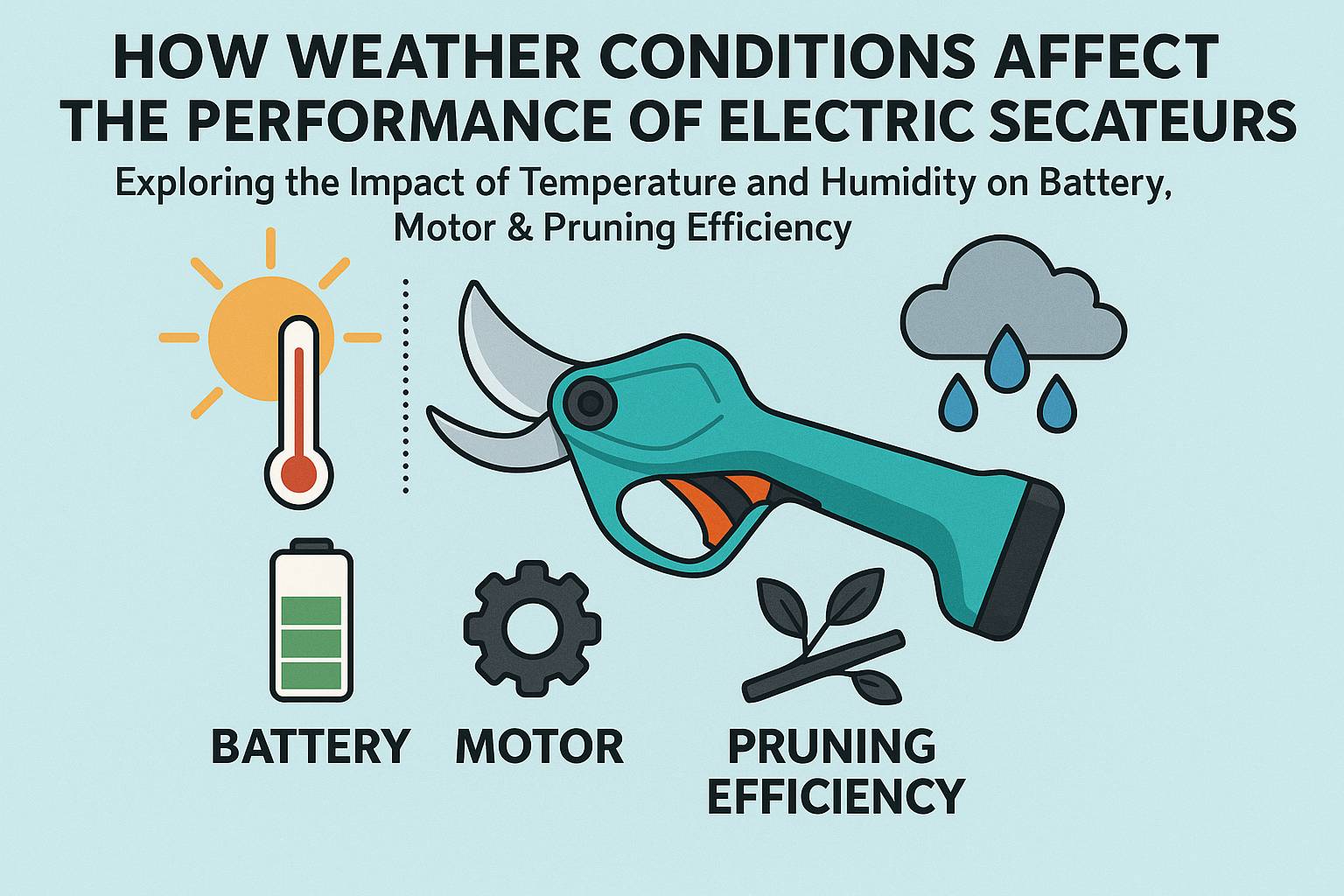
Exploring the Impact of Temperature and Humidity on Battery, Motor & Pruning Efficiency
1. Introduction
Electric secateurs (cordless pruning shears) are powerful and portable — but their performance can be significantly affected by environmental conditions, especially temperature and humidity. Understanding how weather impacts battery efficiency, motor power, and longevity is essential for both home gardeners and professional users. Below, we examine the science behind these effects, supported by peer-reviewed research.
2. Effects of Low Temperature on Battery Performance
2.1 Reduced Capacity and Increased Internal Resistance
- At low temperatures, the internal resistance of lithium-ion batteries rises sharply, impairing ion movement and reducing capacity. A review study found that at −20 °C, capacity can drop by over 30% compared to room temperature. MDPI
- Experimental research (RSC Advances) demonstrated that at 0 °C, battery ageing accelerates: capacity decay rates per cycle increase, and structural damage (to electrode and separator) occurs over repeated cycling. RSC Publishing
- In very cold conditions, uneven temperature distribution within the battery cell further destabilizes performance, as measured in low-temperature tests. PubMed
2.2 Material Degradation Under Extreme Cold
- Studies at SLAC (Stanford) show that extremely low temperatures can cause cathode particles in Li-ion batteries to crack. These micro-cracks degrade the electrochemical integrity over cycles, reducing long-term performance. SLAC National Accelerator Laboratory
- A review on low-temperature battery modelling confirms that charge transfer impedance increases at low temperature, and electrolyte viscosity rises, both of which hurt efficiency. MDPI
2.3 Mitigation: Thermal Insulation & Management
- The RSC Advances study also tested using insulation materials (IM) around battery cells. They found that wrapping a battery in a 10 mm-thick insulation significantly improved discharge capacity at 0 °C and slowed capacity decay. RSC Publishing
- Thermal management models (e.g., phase-change materials) have also been proposed as effective methods to buffer temperature fluctuations in batteries. arXiv
- More advanced strategies include active thermal management systems that dynamically heat/cool the battery during use or charging. One recent control-model study demonstrated such systems can maintain performance even in extreme ambient temperatures. arXiv
3. Effects of High Temperature on Battery & Motor
3.1 Accelerated Degradation and Thermal Stress
- High ambient temperatures (above ~45-50 °C) accelerate internal chemical reactions, leading to faster capacity fade and possibly damaging electrode materials. A critical review shows that elevated temperatures degrade both consistency and safety of lithium-ion cells. MDPI
- According to thermal characterisation studies, when battery temperature rises, internal resistance can increase unevenly across cells. arXiv
- Heat also stresses motor components: while specific pruning-shear motor studies are limited, in general, DC and brushless motors suffer reduced efficiency or increased wear when operating in hot, humid conditions for extended periods.
3.2 Implications for Electric Secateurs
- In very hot weather, secateurs may overheat more quickly, reducing continuous cut time or triggering protective shutdowns.
- Battery aging is accelerated, reducing overall lifespan.
- Without proper thermal design (venting or insulation), performance inconsistencies may arise and reduce reliability in professional or high-frequency use.
4. Impact of Humidity and Moisture
4.1 Electrical Risk and Corrosion
- High humidity can lead to moisture ingress, especially in lower-grade or poorly sealed tools, increasing the risk of short circuits or corrosion of metal components (contacts, springs, motor).
- Moisture exacerbates wear on blade pivot points, potentially increasing mechanical resistance and reducing cutting efficiency.
4.2 Performance Degradation
- Moisture can reduce battery efficiency if condensation forms inside the pack, particularly when combined with temperature cycling (e.g., early morning dew + battery heating during use).
- For tool longevity, using pruners in damp conditions should be paired with post-use drying and proper storage.
5. Practical Recommendations for Gardeners & Professionals
- Pre-Warm Batteries in Cold Weather
- If working in low temperatures (e.g., near 0°C), store your battery in a warm place before use. Consider wrapping with insulating material for prolonged cold operation.
- Avoid charging when the battery is very cold — unless your tool supports thermal management — to reduce stress.
- Use Thermal Management When Possible
- For professional or frequent users, use tools (or select models) with built-in or add-on thermal systems (insulation, active heating) to maintain performance in cold.
- In hot climates, allow tools to cool between periods of heavy use; avoid continuous operation in full sun without ventilation.
- Dry and Maintain Tools After Use
- After pruning in humid or wet conditions, dry the tool thoroughly.
- Lubricate pivot points, especially if moisture was present, to prevent corrosion.
- Store batteries in a dry, stable environment; avoid leaving them in damp sheds or exposed to moisture.
- Choose Tools with Robust Sealing
- Prioritise secateurs that advertise IP-rated water/dust resistance — these are better suited for humid climates.
- Higher-end tools may offer better sealing for both battery pack and motor.
6. Why This Matters for OEMs, Brands & Distributors
- Understanding weather-related performance helps brands design more reliable cordless secateurs that match specific climate markets (cold, temperate, tropical).
- Offering thermal-management options can be a unique selling point, differentiating your tools in a competitive landscape.
- Highlighting weather-resilience in marketing (e.g., “cold-weather rated”) improves trust among professional buyers in regions with seasonal extremes.
7. Conclusion
Weather conditions — especially temperature and humidity — significantly influence the performance, durability, and safety of electric secateurs. Low temperatures reduce battery capacity and increase internal resistance, while high temperatures accelerate degradation. Moisture poses additional risks of corrosion.
By choosing appropriate thermal-management strategies and maintaining tools properly, users can preserve performance and extend the life of their cordless pruning tools. For manufacturers and brands, designing secateurs with weather resilience is becoming increasingly important for global markets.